

Advanced Program in Generative AI and Machine Learning
- Global credentials from Australia’s #1 university
- Masterclasses from the University of Melbourne faculty
- Hands-on learning with domain experts through live sessions and projects
- 3 IBM certifications in Deep Learning, Responsible AI and GenAI with Python
Future-Proof Your Career
Emeritus and The University of Melbourne unite to offer an exclusive opportunity. Enroll by Invalid liquid data and get USD 450 program fee benefit. Limited seats available. Reserve your spot today!
Advanced generative AI training with a global edge
In an increasingly competitive landscape where employers prioritise adaptability and AI fluency, this program helps you build the credibility and depth to lead transformation—across roles, functions and industries.
72%
25%
$7.9 T
Why choose the University of Melbourne
#1
#19
Source: QS World University Rankings 2026 / QS Graduate Employability 2022 / QS World University Rankings By Subject 2025
Program Highlights

Self-paced learning with recorded GenAI & ML lectures

Live masterclasses and expert-led interactive sessions

Hands-on practice with 25+ tools and 20+ real-world projects

Three optional IBM certificates in AI and GenAI

Two-week industry-relevant capstone project

Career guidance with GitHub portfolio review
Decode global frameworks in machine learning and AI

Master data science foundations, applications, and pathways

Apply maths, statistics, and programming to build core AI/ML algorithms

Develop transformer-based NLP models for generation and translation

Build deep learning systems for vision and speech recognition

Design reinforcement learning agents for complex decision-making

Deploy ML models using Flask and Streamlit for real-world applications
Who is this designed for?
This program is for professionals who want to leverage GenAI and ML to innovate, solve complex problems, and stay ahead in a fast-evolving tech landscape — whether you’re a technical expert deepening your skills or a non-technical leader exploring AI’s potential.
Ideal for:
Data scientists & analysts: Advance in cutting-edge AI, ML, and generative AI tools.
Software engineers: Transition to AI/ML roles or enhance projects with AI.
Business analysts & consultants: Use AI for data-driven insights and strategy.
Product managers & owners: Integrate AI/ML into product roadmaps.
By the end, you will:
Lead GenAI initiatives to boost efficiency and solve challenges.
Understand AI roadmaps like Agentic AI for organisational growth.
Make data-driven decisions using AI-powered insights.
Collaborate effectively with AI/ML teams.
Stay future-ready with the latest AI advancements.
An industry-leading curriculum for all your skill needs
Pillar I: Fundamentals
Module Name: Introduction to Data Science
Learners will understand what data science is, its history, learning path, and the impact and scope of the field.
They will reflect on their own data science journeys and articulate their learning expectations.
The module will cover what learners anticipate about data science and where they see its future applications.
Module Name: Mathematics and Statistics Fundamentals
Topics include vectors, scalars, matrices, matrix operations, determinants, and the role of statistics in data science.
Learners will work with different types of data, descriptive statistics, and an introduction to probability distributions.
Inferential statistics, hypothesis testing, confidence intervals and test statistics such as the Z-test and T-test will be covered.
Module Name: Python Fundamentals
The module includes Python data structures like lists, tuples, sets, dictionaries, and control structures.
Learners will explore file handling, comprehensions, OOPs, generators and foundational Python libraries.
Pillar II: Data Exploration
Module Name: Data Analysis and Git Fundamentals
Participants will perform data operations using Excel, SQL aggregations and Git-based version control.
The module includes using libraries like NumPy, Pandas, Matplotlib, SciPy and Scikit-learn for exploratory data analysis.
Module Name: Data and Feature Engineering
This module covers data cleaning, feature selection, and normalisation techniques.
Participants will engage in hands-on exercises, case studies and classroom discussions to build expertise.
Pillar III: Machine Learning
Module Name: Supervised Learning – Regression
The module covers linear regression, evaluation metrics, polynomial regression and overfitting scenarios.
Strategies to address overfitting and enhance model generalisability will also be introduced.
Module Name: Supervised Learning – Classification
Topics include logistic regression, decision trees, random forests and support vector machines.
Model deployment basics such as saving, loading and predicting will also be introduced.
Module Name: Unsupervised Learning
Participants will apply distance metrics and clustering algorithms such as agglomerative clustering.
Techniques like PCA, association rule mining, DBSCAN and anomaly detection will be explored.
Module Name: Ensemble Modelling
The module covers bagging and boosting methods, including Adaboost, XGBoost, CatBoost and Gradient Boosting.
The differences between supervised, unsupervised and ensemble approaches will be discussed in context.
Module Name: Time Series Modelling
Learners will work with types of time series data, ARIMA, AR, MA, and Facebook Prophet.
They will apply forecasting techniques to practical data scenarios.
Module Name: Recommendation Engine
Topics include similarity measures like Pearson correlation and cosine distance, and recommendation types.
Learners will explore various libraries and frameworks to build personalised recommendation engines.
Pillar IV: Advanced Deep Learning
Module Name: Model Evaluation and Deep Learning Fundamentals
Topics include cross-validation, activation functions and popular DL frameworks.
Learners will also practise neural network implementation for common use cases.
Module Name: Neural Network Basics
Learners will learn about perceptrons, MLPs and the mathematics behind forward propagation.
Python-based implementation of neural networks will be covered.
Module Name: Deep Learning Optimisation
The module covers optimisers, activation and loss functions, batch normalisation and dropout techniques.
Best practices in selecting suitable functions for various model types will also be addressed.
Module Name: Convolutional Neural Networks (CNNs)
Topics include filters, pooling, padding, strides and CNN architecture.
Learners will also work with pre-trained models, transfer learning and fine-tuning.
Module Name: Recurrent Neural Networks (RNNs)
Learners will explore the structure and applications of RNNs, LSTMs, GRUs and attention mechanisms.
The module also introduces transformers for sequence-based tasks.
Module Name: Unsupervised Learning – Advanced
Topics include autoencoders, Deep Belief Networks and Restricted Boltzmann Machines.
Learners will explore their application in real-world scenarios.
Pillar V: Generative AI
Module Name: Generative AI
This includes Variational Autoencoders, GANs, WGANs, DCGANs and training methodologies.
Participants will build and apply generative architectures for text and image tasks.
Module Name: Natural Language Processing (NLP)
Topics include preprocessing, tokenisation, word embeddings, and sequence modelling.
Learners will use models like RNNs, LSTMs and GRUs for NLP applications.
Module Name: Transformers
Learners will understand attention mechanisms and architectures like GPT, BERT and T5.
Use cases include machine translation, summarisation and text generation.
Pillar VI: Computer Vision
Module Name: Computer Vision
The module includes image processing, object detection, segmentation and video analysis.
Topics such as self-supervised and few-shot learning will also be explored.
Pillar VII: Advanced Deep Learning
Module Name: Reinforcement Learning
Learners will explore key concepts, Bellman equations and Markov Decision Processes.
Techniques like temporal difference learning, Monte Carlo methods and Q-learning will be implemented.
Module Name: Deep Reinforcement Learning
Topics include DQN architectures, policy gradients, hierarchical and multi-agent RL.
Participants will work on real-world applications of deep RL.
Pillar VIII: LLMs and Applications
Module Name: Large Language Models (LLMs)
Topics include pretraining, fine-tuning, prompt engineering and vector embeddings.
Applications in text generation, content creation and automation will be covered.
Module Name: Agentic AI and RAG
Topics include memory, goal setting, vector databases like FAISS, and RAG architecture.
Participants will integrate retrieval with generation for improved contextual accuracy.
Pillar IX: Ethical AI
Module Name: Ethical AI
Topics include responsible AI principles, bias mitigation, LIME, SHAP, and audit tools.
Legal frameworks like GDPR, DPDP and the EU AI Act will be covered.
Module Name: Streamlit for ML App Development
Learners will explore the basics of Streamlit including its layout, widgets and text elements.
They will create and test interactive applications that showcase machine learning models and outputs.
Module Name: Deployment and MLOps
Participants will understand the ethical considerations of deploying models, particularly in sectors like banking and e-commerce.
They will learn to implement Responsible AI and Explainable AI principles within deployment workflows.
The module includes hands-on training in model versioning, data monitoring and managing model registries.
Capstone Project
Learners will work on an end-to-end project that integrates data exploration, model development and deployment strategies.
The capstone will allow participants to demonstrate their proficiency across tools, frameworks and best practices covered throughout the program.
University of Melbourne Faculty

Prof. Eduard Hovy
Executive Director, Melbourne Connect | Professor, University of Melbourne | Adjunct Professor, Carnegie Mellon University
Prof. Hovy is the Executive Director of Melbourne Connect, a research and technology transfer centre at the University of Melbourne. He is also a Professor in the School of Co...

Dr. Jey Han Lau
Senior Lecturer, School of Computing and Information Systems, University of Melbourne
Academic & Professional Background:
- Ph.D., Graduate Certificate, and Bachelor’s Degree – University of Melbourne
- Senior Lecturer in Natural Language Processing (NLP), Scho...
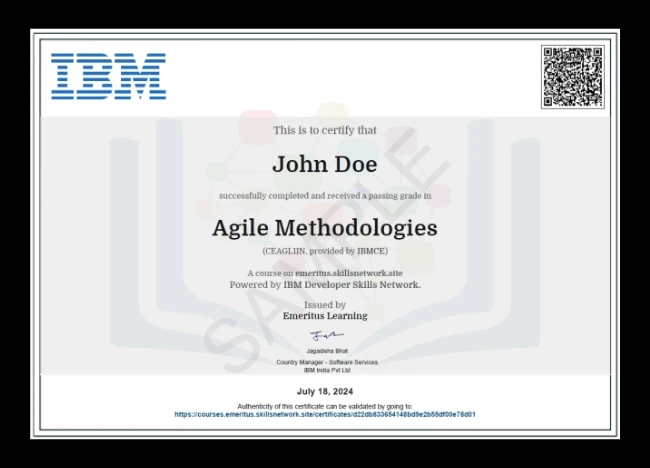
IBM certifications
Certification I: Deep Learning with TensorFlow
Master the TensorFlow ecosystem and apply it to real-world deep learning problems, from curve fitting to advanced neural architectures.
Certification II: Responsible and Ethical Generative AI
Develop a principled approach to GenAI by understanding ethical, social and environmental considerations in its design and deployment.
Certification III: Developing Generative AI Applications using Python
Gain hands-on experience building intelligent applications—chatbots, voice assistants and more—using Python, LLMs, RAG and IBM watsonx.
Note: IBM Certifications are optional and are spread across the program duration. IBM content is hosted on the IBM portal but accessible via the course LMS.
Hands-on projects

Sentiment Analysis on Twitter data with Recurrent Neural Networks

Advanced Clustering with DBSCAN and GMM

GANs for High-Resolution Image Generation

Text Classification with NLP Models

CNN for Image Classification

Fine-tune Large Language Models for Text Generation
Tools covered

















Real-world use cases

Style Transfer: Use GANs to apply artistic styles to digital images.

Movie Recommendation System: Build a personalised recommendation system using collaborative filtering.

Training an AI for Simple Games: Apply deep reinforcement learning to train game-playing agents.

Image Classification with CIFAR-10: Optimise and fine-tune deep learning models for image classification tasks.

Gridworld Navigation: Train reinforcement learning agents to navigate Gridworld environments.

Building API for Weather Data: Develop RESTful APIs for delivering real-time weather information.

CI/CD Pipeline for ML Models: Deploy scalable ML models using container orchestration tools.

Predicting Loan Defaults: Enhance prediction accuracy using ensemble learning methods.

Analysing Loan Data to Identify Default Risk: Model borrower behaviour to assess the likelihood of loan defaults.
Career Services Included

Resume-builder tool
6-month access to DIY resume builder
Auto resume creator with optimisation suggestions
Unlimited resume iterations within the duration

Career preparation modules
Resume and cover letter essentials
Maximising LinkedIn and job search strategy
Interview preparation and personal branding

GitHub profile building guidance
Get and edge in the market with your digital portfolio on GitHub. Share code and collaborate with other data science enthusiasts on projects that add credibility to your resume. Additionally, you will also:
Create your own profile or optimise your existing one.
Publish two projects (including the Capstone Project) on your GitHub portfolio.
Get insights from domain experts on how/why GitHub is a key differentiator in the interview process.
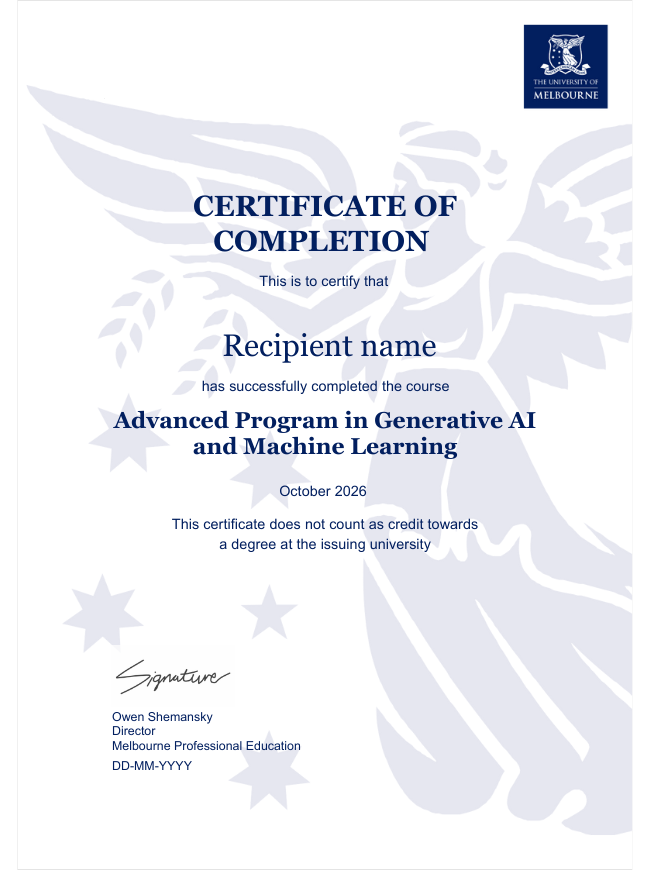
Certificate
To successfully complete the program and receive a Certificate of Completion, learners must achieve a minimum overall score of 70% on all mandatory assignments, secure at least 70% on the Capstone Project, and maintain a minimum of 50% attendance in live sessions.
FAQs
How is the program teaching split between University of Melbourne faculty and industry experts?
This program is taught by both University of Melbourne faculty and domain experts. Weekly recorded lectures and weekly live sessions are conducted by domain experts.
Who grades/reviews assignments and projects?
Assignments will be graded by industry practitioners who support participants in their learning journeys and/or by the Emeritus grading team.
Will the institute/Emeritus help with placement services?
This program is designed with some of the best faculty to cover relevant topics in a manner that creates positive career outcomes. Career prep modules on resumes, LinkedIn profile optimisation, job navigation and interview preparation are also provided.
What if I don’t find the program appropriate for me after starting the sessions? Can I seek a refund?
We encourage our learners to complete the program to fully understand the concepts and derive valuable learning outcomes. Absent a previous approved request for deferral for the course, learners may request a full refund of all course and miscellaneous fees paid, within fourteen (14) days after course commencement. Application fees for courses are non-refundable and non-transferable. Learners who have previously been granted a course deferral are not eligible for a refund for the course. Partial (or pro-rated) refunds are not offered.
What type of certificate will I receive?
Upon successful completion of the program, you will receive a smart digital certificate. This can be shared with friends, family, schools, or potential employers. You can use it in your cover letter and resume and/or display it on your LinkedIn profile.
For how long will I have access to the learning materials?
You will have access to the online learning platform and all the videos and program materials for 12 months following the program end date. Access to the learning platform is restricted to registered participants per the terms of the agreement.
Is there a qualifying mark/grade to get the final certification in this program?
Yes, the qualifying mark is 70% on all mandatory assignments and successfully complete the capstone project.
Register as soon as possible. Space is limited.
Flexible payment options available.
Starts On